
Bombay high court Chief Justice Alok Aradhe and Patna high court Chief Justice Vipul Manubhai Pancholi were on Wednesday elevated as judges of the Supreme Court, the government said.
A plea has been filed in the Supreme Court seeking the removal of Madhya Pradesh minister Vijay Shah for his remarks against Indian Army officer Col Sofiya Qureshi. The petition, filed by a Congress leader, alleges Shah's statement sparks separatist feelings and threatens the country's unity.

The SC has sought a response from the Centre on a plea seeking the restoration of statehood to Jammu and Kashmir.
Wanted to bring Sports Bill to SC's notice first: AIFF on flip-flop over mentioning of ISL issue

An Egyptian court on Monday overturned President Muhammed Mursi's decree that had called for parliamentary elections from April 22, questioning its constitutionality, a ruling that may deepen the political crisis in the polarised country.
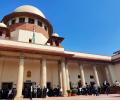
The bench, which also comprised justices AS Oka, JB Pardiwala, Pankaj Mithal and Manoj Misra, pronounced two separate but concurring judgements in the matter.
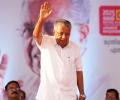
Kerala Chief Minister Pinarayi Vijayan questioned the attempts being made to implement the SIR in poll-bound Kerala, Tamil Nadu and West Bengal while the Constitutional validity of the Bihar SIR process is under consideration by the Supreme Court.
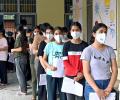
As the petition points out, new medical colleges entail adjunct government hospitals, thus making specialised medical care that much more accessible to the vast majority of population that otherwise could not afford high-cost medical care in the private sector, N Sathiya Moorthy points out.

The Supreme Court has put on hold several key provisions of the Waqf (Amendment) Act, 2025, including the clause that only those practicing Islam for the last five years can dedicate a property as Waqf. The court also addressed the powers of collectors and non-Muslim participation in Waqf Boards.
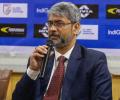
AIFF invites bids from consulting firms to manage process of awarding commercial rights.

The Deepa Thoon controversy, if not allowed to die a natural death, could take the election focus away from the anti-incumbency impacting the DMK and into the secular space. Stalin would love to have it that way, all over again, after the three past elections, points out N Sathiya Moorthy.

The first five courtrooms of the Supreme Court have become WiFi-enabled, Chief Justice of India (CJI) D Y Chandrachud announced on Monday, in a significant step towards the digitisation of the top court.
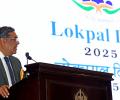
The Supreme Court of India will examine the jurisdiction of the Lokpal, India's anti-corruption ombudsman, in entertaining complaints against sitting high court judges. The court is considering a suo motu proceeding initiated over the Lokpal's January 27 order on the issue. The case involves two complaints filed against a sitting additional judge of a high court, alleging that he influenced a judge of the subordinate judiciary and a judge of the same high court set to deal with a suit filed against the complainant by a private company.
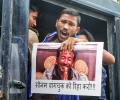
The Supreme Court has sought responses from the Centre and the Ladakh administration regarding the detention of climate activist Sonam Wangchuk under the National Security Act (NSA). Wangchuk's wife has filed a plea challenging the detention, claiming it violates his fundamental rights. The court has given the Centre and Ladakh administration 10 days to respond and has scheduled the next hearing for November 24.

Jailed activist Sonam Wangchuk has appealed to the people of Ladakh to maintain peace and unity and continue with the ongoing struggle for statehood and safeguards under the Sixth Schedule of the Constitution in the true Gandhian way of non-violence, his lawyer said on Sunday.

The Assam assembly on Thursday passed a bill to ban polygamy, making it an offence which may lead to a maximum of 10 years of imprisonment, barring some exceptions.
10 ISL clubs slam AIFF for delay in tender process, allege "breach of trust"

'Life in India is better only for those who have reservations.'

SC-appointed Justice Rao recommends striking balance between AIFF autonomy and bidders' interests
11 ISL clubs urge AIFF to urgently bring "current situation" of Indian football to SC's attention

Will negotiate with FSDL to arrive at mutually agreeable measures: AIFF after SC hearing

The Supreme Court has questioned the delay in the hanging of Balwant Singh Rajoana, convicted in the 1995 assassination of former Punjab CM Beant Singh, despite the Centre calling it a 'serious offence'.

The Supreme Court of India dissolved a marriage, instructing the couple to prioritize their child's well-being and set aside personal differences.
ISL, I-League clubs to meet Sports Minister after talks with AIFF chief Chaubey fail to end deadlock

The Election Commission has warned against the use of bulk SMSes and audio messages during the 48-hour 'silence period' before the conclusion of voting in the Bihar assembly polls. The EC has also mandated pre-certification of political advertisements on electronic media, including social media.
Climate activist Sonam Wangchuk's wife, Gitanjali J Angmo, claims his speeches were quoted out of context and wrongly translated to support an 'anti-national narrative' in his detention order. She asserts the charges are frivolous and will be challenged in court.
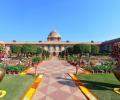
The Supreme Court has ruled that a Governor cannot send bills to the President for consideration if the state assembly has already cleared them for a second time. The court was questioning the Centre over the powers of the Governor when it comes to granting assent to bills.
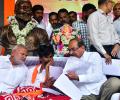
The BJP-led government's decision to grant Kunbi status to individuals from the Maratha community has opened a Pandora's box.
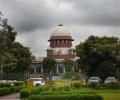
The Supreme Court has raised concerns about discrimination against persons with disabilities in employment, questioning the Centre on the lack of 'upward movement' for meritorious candidates. The court also ordered nationwide monitoring of care institutions for persons with cognitive disabilities.

The Supreme Court issued interim directions permitting the sale and bursting of green firecrackers in Delhi and the National Capital Region (NCR) during Diwali, outlining specific rules and restrictions.

Justice A M Khanwilkar, the second senior-most judge of the Supreme Court, retired on Friday and thanked bar association leaders for their 'love and affection'.

ISL Imbroglio: AIFF calls for meeting between legal counsels of federation and clubs

'Khalid will have to begin with consistency and with new players and good strikers from U-23 because he has to build for the future.'

Bombay High Court Chief Justice Dipankar Datta was on Monday administered the oath of office as a Supreme Court judge by Chief Justice of India (CJI) D Y Chandrachud.

A bench of Justices B R Gavai and K V Viswanathan clarified that its order will not be applicable to unauthorised structures on public roads, footpaths etc.

'The current Election Commission functions more like a government department than an autonomous body.'
The Supreme Court on Monday pulled up Madhya Pradesh minister Kunwar Vijay Shah for not issuing a public apology over his remarks against Indian Army officer Colonel Sofiya Qureshi, saying he is testing the court's patience.
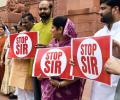
The Supreme Court has warned that it will set aside the special intensive revision (SIR) of electoral rolls in Bihar if any illegality is found. The court is reviewing the validity of the Bihar SIR and its potential impact on a similar exercise across India.

The Supreme Court refused to stay a provision barring the declaration of tribal lands as waqf properties, upholding key provisions of the Amended Waqf Act.

Dhankhar said every word spoken by a constitutional functionary is guided by the supreme sublime interest of the nation.
